By God's grace, I graduated from Southern Seminary on Friday, December 13th. This meant that, in December, I suddenly had an unusual amount of time on my hands for reading, and consequently I read three books: the second and third books of Brandon Sanderson's Mistborn trilogy, and A Christmas Carol, by Charles Dickens.
I'll just make a few comments about Mistborn. I originally became interested in the series from reading another set of works by the author. When Robert Jordan, author of the epic Wheel of Time series, passed away leaving that saga unfinished, Brandon Sanderson was tapped to gather Jordan's notes and deliver the conclusion fans of that series had been waiting more than twenty years to read. Sanderson did a fine job with The Gathering Storm, Towers of Midnight, and the climactic A Memory of Light, and since these books meant I'd never have another Wheel of Time tome to read, I decided to investigate his original works to see how they held up.
Comparisons across the fantasy genre are notoriously difficult; just stop into your local comic book store and wait for the inevitable fanboy disputes over Star Trek vs. Star Wars. Or don't. The point is, such comparisons inevitably reveal as much about the subjective preferences of individual readers as they do about the quality and imaginative force of a given series.
That said, the Mistborn trilogy is a happy medium between the grand, sweeping scale of a Wheel of Time or Lord of the Rings, and the smaller casts and scale of R.A. Salvatore's works, or of Harry Potter. Mistborn focuses on a small cast of characters with a single heroine, Vin, with (initially) modest goals, who are eventually swept up in events with much more at stake.
Sanderson's world is an imaginative one, primarily populated with humans, but with a few other spectacular creatures sprinkled in as well. Notably, each of these creatures has an important creation story, and are thus much more than atmospheric fluff. Perhaps most impressive of all is the magical system of Mistborn; a unique art called Allomancy, which is powered by individual magic users (called Mistings and Mistborn) consuming and then "burning" various metals to give off different effects. These are relatively simple, even unspectacular, but Sanderson has a flair for combat scenes and problem-solving episodes, and the characters of Mistborn never fail to produce some innovative new use of their powers.
Said characters are, admittedly, a mixed bag. There are few cookie-cutter good guys or bad guys, and some of the secondary characters (Marsh, Sazed, and Breeze were all favorites of mine) are satisfyingly complex. Yet Vin, around whom the entire series revolves, never really "did it" for me. Her personal struggles with trust and identity never seem to have any truly damaging consequences, and all resolve neatly at just the right time. Beyond that, Vin comes across as the typical peasant-turned-savior of the fantasy world, conveniently altruistic and self-sacrificial. Yet, despite his failings in crafting his main character, Sanderson manages an impressive, even astonishing, twist in the books final pages, that manage to elevate Mistborn above the cliche pitfalls of its genre.
Mistborn will never be spoken of in the same breath as The Lord of the Rings, but I found it an engrossing read, and I eagerly look forward to reading the rest of the Sanderson corpus as quickly as possible. That is, unless someone digs up a lost Robert Jordan novel for me to read first.
Tuesday, February 4, 2014
Sunday, January 26, 2014
#1. Learn to sew. AND #5. Go to 3 Hard Rock Cafes I haven't visited before. (1/3) AND #14. Read a new book every month, including one that Tom recommends.
Phew! My Thanksgiving break was pretty eventful; I completed one goal, started on a new one, and made more progress on another one!
I've wanted to learn to use a sewing machine for years now. It just seems like one of those things women should know how to do, even if they just use it for fixing hems or other simple things like that. Anyway, I finally got my chance; while Tom and I were at his parents' house for Thanksgiving, my mother-in-law helped me make a pair of flannel pajama pants!
I used the fabric scraps to have some fun with Roy the cat (or, as I like to call him, Crazy Eyes LaRue).
I didn't actually wear the pants until after we got back to Louisville. The first time I wore them, I found this in our bed the next morning...
Oops! I thought I'd gotten all the pins out when we finished sewing the pants. Glad Tom and I don't have a water bed...! I'm also glad the pin got stuck in the mattress and not in, well, me.
By the way, my in-laws gave me an early birthday present while we were in Clarksville: a brand-new sewing machine! So now I have no excuse not to keep up with it.
The day after Thanksgiving, we all went to Nashville to see The Story. (After nearly two decades of fandom, I finally got to see and hear Steven Curtis Chapman live and in person. Aaaahhhh!) Before the show, we went to dinner at the Nashville Hard Rock Cafe. This was one of the cooler HRCs I've visited. The decor is clean and modern with a slightly urban feel, and the service was excellent. But what made this HRC visit really unique was that we got to share a meal with a couple of very special guests. One of Tom's professors, Dr. Coppenger, lives in Nashville; and Tom invited him and his wife to come meet up with us for dinner that evening. We had a great time with them!
And finally, I finished a great read during Thanksgiving break too: Julia Child's My Life in France. I honestly never really knew much about Julia Child until I saw the movie Julie & Julia, which quickly became one of my favorites. Then I came across this book a few years ago during a big closeout sale at our local Borders (I had to decide between this and Rue McClanahan's autobiography...a very tough call for me!). I learned that she actually didn't know much about cooking for the first half of her life, but then she and her husband Paul moved to France for his job, and her life was completely transformed. She fell in love with the people, the culture, and most importantly, the food. What made her story really interesting is that she discovered her love of French cooking during a time when France was not really at its best; she moved there shortly after the end of World War II, and the country was war-torn. Amidst all the descriptions of dishes like soufflé Grand Marnier and sole meunière were descriptions of buildings in ruins and people whose lives had been shattered by the war. But to hear Ms. Child describe the country as a whole, one would think it was the greatest place on earth. She seemed to be able to find the good in everything. She had such joie de vivre, it's no surprise that she made the most of her time there and eventually became one of the most-loved TV personalities of our time. (By the way, I really tried to come up with a non-French way of describing her personality for fear of sounding cliché, but nothing seemed as accurate as joie de vivre, which means "enjoyment of life.") I so enjoyed getting to know her through this book. She seemed like such a lovely person. And it makes me want to read other cooking-memoir books like this. It's fun to read about people who love cooking as much as I do and are more well-written than I am. :)
I've wanted to learn to use a sewing machine for years now. It just seems like one of those things women should know how to do, even if they just use it for fixing hems or other simple things like that. Anyway, I finally got my chance; while Tom and I were at his parents' house for Thanksgiving, my mother-in-law helped me make a pair of flannel pajama pants!
I used the fabric scraps to have some fun with Roy the cat (or, as I like to call him, Crazy Eyes LaRue).
I didn't actually wear the pants until after we got back to Louisville. The first time I wore them, I found this in our bed the next morning...
Oops! I thought I'd gotten all the pins out when we finished sewing the pants. Glad Tom and I don't have a water bed...! I'm also glad the pin got stuck in the mattress and not in, well, me.
By the way, my in-laws gave me an early birthday present while we were in Clarksville: a brand-new sewing machine! So now I have no excuse not to keep up with it.
The day after Thanksgiving, we all went to Nashville to see The Story. (After nearly two decades of fandom, I finally got to see and hear Steven Curtis Chapman live and in person. Aaaahhhh!) Before the show, we went to dinner at the Nashville Hard Rock Cafe. This was one of the cooler HRCs I've visited. The decor is clean and modern with a slightly urban feel, and the service was excellent. But what made this HRC visit really unique was that we got to share a meal with a couple of very special guests. One of Tom's professors, Dr. Coppenger, lives in Nashville; and Tom invited him and his wife to come meet up with us for dinner that evening. We had a great time with them!
And finally, I finished a great read during Thanksgiving break too: Julia Child's My Life in France. I honestly never really knew much about Julia Child until I saw the movie Julie & Julia, which quickly became one of my favorites. Then I came across this book a few years ago during a big closeout sale at our local Borders (I had to decide between this and Rue McClanahan's autobiography...a very tough call for me!). I learned that she actually didn't know much about cooking for the first half of her life, but then she and her husband Paul moved to France for his job, and her life was completely transformed. She fell in love with the people, the culture, and most importantly, the food. What made her story really interesting is that she discovered her love of French cooking during a time when France was not really at its best; she moved there shortly after the end of World War II, and the country was war-torn. Amidst all the descriptions of dishes like soufflé Grand Marnier and sole meunière were descriptions of buildings in ruins and people whose lives had been shattered by the war. But to hear Ms. Child describe the country as a whole, one would think it was the greatest place on earth. She seemed to be able to find the good in everything. She had such joie de vivre, it's no surprise that she made the most of her time there and eventually became one of the most-loved TV personalities of our time. (By the way, I really tried to come up with a non-French way of describing her personality for fear of sounding cliché, but nothing seemed as accurate as joie de vivre, which means "enjoyment of life.") I so enjoyed getting to know her through this book. She seemed like such a lovely person. And it makes me want to read other cooking-memoir books like this. It's fun to read about people who love cooking as much as I do and are more well-written than I am. :)
Wednesday, January 1, 2014
34. Read a new book every month, including one that Esther recommends.
Wow. I am really far behind in posting.
For Novemeber, I read James Hornfischer's Neptune's Inferno: The US Navy at Gudalcanal.
I first became acquainted with Hornfischer when I heard him speak via podcast at the Prtizker Military Library in Chicago. At that time, he was speaking about an earlier, excellent book, Last Stand of the Tin Can Sailors. This I polished off a few summers ago, and immediately decided I needed to read everything this fellow ever wrote.
What sets Hornfischer apart from other World War II writers is his unique ability to combine in-depth scholarly research with first-hand accounts of battles by the combatants into a blow-by-blow account that almost reads like an historical thriller. Reading Hornfischer is more than just reliving the battles he describes; it's going inside individual shell hits, exploring the devastating effects of a torpedo on a forward magazine in slow motion, and falling to the teak deck of a destroyer with the survivors of a demolished turret. In short, his style is perhaps the most engrossing and simultaneously the most detailed I've come across in my amateur pursuit of military historical scholarship.
At times, however, this strength of Hornfischer's is also his weakness. At times he takes you so far into the battle he's describing, that it can be easy to lose sight of the big picture. The events and decisions leading up to a given action are sometimes described so much in passing that the shells are flying without the reader grasping why.
Still, a terrific read about an incredibly important campaign.
For Novemeber, I read James Hornfischer's Neptune's Inferno: The US Navy at Gudalcanal.
I first became acquainted with Hornfischer when I heard him speak via podcast at the Prtizker Military Library in Chicago. At that time, he was speaking about an earlier, excellent book, Last Stand of the Tin Can Sailors. This I polished off a few summers ago, and immediately decided I needed to read everything this fellow ever wrote.
What sets Hornfischer apart from other World War II writers is his unique ability to combine in-depth scholarly research with first-hand accounts of battles by the combatants into a blow-by-blow account that almost reads like an historical thriller. Reading Hornfischer is more than just reliving the battles he describes; it's going inside individual shell hits, exploring the devastating effects of a torpedo on a forward magazine in slow motion, and falling to the teak deck of a destroyer with the survivors of a demolished turret. In short, his style is perhaps the most engrossing and simultaneously the most detailed I've come across in my amateur pursuit of military historical scholarship.
At times, however, this strength of Hornfischer's is also his weakness. At times he takes you so far into the battle he's describing, that it can be easy to lose sight of the big picture. The events and decisions leading up to a given action are sometimes described so much in passing that the shells are flying without the reader grasping why.
Still, a terrific read about an incredibly important campaign.
Tuesday, November 19, 2013
#27. Decide on a go-to chocolate chip cookie recipe.
I think every household should have a good chocolate chip cookie recipe (or proximity to a grocery store that sells break-and-bake dough...or, you know, actual cookies). I love to bake, so I prefer homemade cookies to pre-made cookies or dough. (I don't discriminate, though. Cookies are one of my favorite desserts, so I will eat them in just about any form.) But somehow, in all my baking adventures, I have never decided on a go-to chocolate chip cookie recipe, and I am on a quest to resolve that. I tend to be a bit obsessive methodical in my decision-making, and since I love cookies so much, this will certainly be no exception. My plan is to test several recipes and grade them, and the one with the highest grade will become my go-to.
Here are the ground rules:
I will not be considering "alternative" recipes that might include ingredients like nuts or caramel. I may test recipes with some sort of enhancer like vanilla pudding, maybe even cream cheese, but nothing that changes the overall flavor. Just straight-up, classic chocolate chip cookie goodness.
These are the factors by which I will grade each recipe (1-5 rating for each item):
So, now that that's out of the way, let's get to it! The first recipe in my quest for the perfect chocolate chip cookie comes to us from Betty Crocker.
Here are the ground rules:
I will not be considering "alternative" recipes that might include ingredients like nuts or caramel. I may test recipes with some sort of enhancer like vanilla pudding, maybe even cream cheese, but nothing that changes the overall flavor. Just straight-up, classic chocolate chip cookie goodness.
These are the factors by which I will grade each recipe (1-5 rating for each item):
- Taste: Like I said, it has to have an unmistakable chocolate chip cookie taste. (Duh.)
- Texture: I like my cookies to be somewhat thick, slightly crisp around the edges, and soft and chewy in the middle. So that's what I'll be looking for.
- Convenience: How many steps? How many ingredients? Are the ingredients ones that I already have on-hand, with the exception of chocolate chips?
- WW-friendliness: How many WeightWatchers points per cookie? I'm not expecting them to be health food or anything, but would prefer them to be as low in points as possible. According to my tracker, the average for a homemade chocolate chip cookie is 2 points.
- Accuracy: I will be following each recipe exactly, so what I'm looking for here is if my attempt looks like the photo and/or lives up to any hype surrounding the recipe.
So, now that that's out of the way, let's get to it! The first recipe in my quest for the perfect chocolate chip cookie comes to us from Betty Crocker.
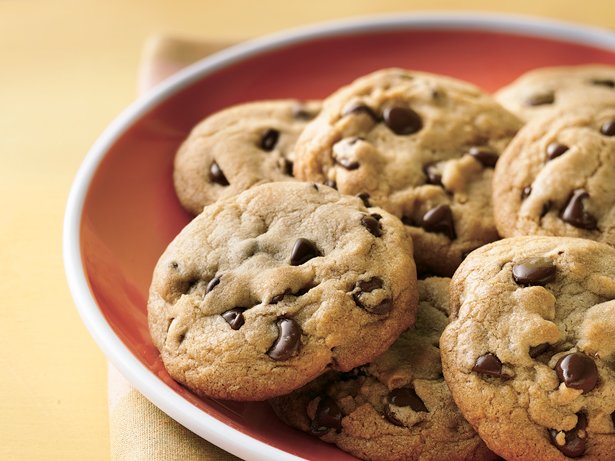
This is Tom's last week of seminary classes (yay!), so I made these last night for him to share with his classmates. The recipe was pretty simple. The dough came together nicely in the stand mixer, and the only thing we had to buy for it was a bag of chocolate chips. (Actually, Tom went out and bought more flour and brown sugar last night because I ran out, but that's stuff we usually have in-stock.) The cookies themselves turned out pretty well. I forgot to take a picture of them while they were cooling, but here they are all packed up and ready to go to school...
Mine spread out a bit more than the ones in the photo, so they weren't very thick, but they tasted great, and they were still crisp on the edges and chewy in the middle. I'm guessing they spread so much because of all the butter; I used 3 whole sticks. It was a big recipe (72 cookies), so I guess it wasn't that much in the grand scheme of things, but it did make them pretty greasy, which is somewhat unappealing as far as texture. It came out to 3 WW points per cookie, which isn't terrible but could be better.
Soft and Chewy Chocolate Chip Cookies from Betty Crocker
Taste: 5
Texture: 3
Convenience: 5
WW-friendliness: 4
Accuracy: 4
Final grade: 21/25
Monday, November 18, 2013
#34. Read a new book every month, including one that Esther recommends. (1/10)
For October, I read Sir Max Hastings' single volume World War II history, Inferno: The World at War, 1939-1945. I've been a big fan of Hastings ever since I read his D-Day account Overlord for a military history class at Clemson. This is the third book of his I've read, and it was a good one.
World War II is by the far the period of history about which I have read the most, so I was familiar with most of the events and key players. What sets Hastings' book apart is its look at how ordinary people experienced these horrible events. We all know at least a little about what the war was like for Churchill, Stalin, Hitler, and FDR, but Hastings, having combed through thousands of letters, diaries, and memoirs takes his readers into the trenches on the Eastern front, to the daily life in London during the blitz, and into the despair of German housewives as the Russian army closed in in 1945. It is impossible to read a book like this and keep your distance from the people who fought, lost, and won this terrible conflict.
The book is also good for myth-busting and settling controversies. Hastings is never afraid to call out his fellow Brits when he sees the need, nor does he blindly lavish praise on the means used by the Allies to win the day. He is the first historian I've read (though it is an historical reality) to unabashedly give the majority of the credit for defeating the Nazis to the Soviet Union. He admits that they were the only nation willing to pay the enormous cost in blood that was required to bring down the Third Reich, and questions (quite honestly) whether the more civilized US and UK could have stomached such a cost. Finally, his take on the circumstances and moral debate of the use of the atomic bomb is well-informed and persuasive: Hastings takes us from our armchairs to the context of Truman's dreadful, but for Hastings inevitable, decision to use the bomb.
If you are new to World War II studies, this isn't the book with which to start. The anecdotal focus of the book at times causes the big picture to be lost, and so I would recommend reading a more general history of the war first. If you're fairly familiar with the events and want a fresh look, this is the book for you.
Next up, James Hornfischer's Neptune's Inferno.
World War II is by the far the period of history about which I have read the most, so I was familiar with most of the events and key players. What sets Hastings' book apart is its look at how ordinary people experienced these horrible events. We all know at least a little about what the war was like for Churchill, Stalin, Hitler, and FDR, but Hastings, having combed through thousands of letters, diaries, and memoirs takes his readers into the trenches on the Eastern front, to the daily life in London during the blitz, and into the despair of German housewives as the Russian army closed in in 1945. It is impossible to read a book like this and keep your distance from the people who fought, lost, and won this terrible conflict.
The book is also good for myth-busting and settling controversies. Hastings is never afraid to call out his fellow Brits when he sees the need, nor does he blindly lavish praise on the means used by the Allies to win the day. He is the first historian I've read (though it is an historical reality) to unabashedly give the majority of the credit for defeating the Nazis to the Soviet Union. He admits that they were the only nation willing to pay the enormous cost in blood that was required to bring down the Third Reich, and questions (quite honestly) whether the more civilized US and UK could have stomached such a cost. Finally, his take on the circumstances and moral debate of the use of the atomic bomb is well-informed and persuasive: Hastings takes us from our armchairs to the context of Truman's dreadful, but for Hastings inevitable, decision to use the bomb.
If you are new to World War II studies, this isn't the book with which to start. The anecdotal focus of the book at times causes the big picture to be lost, and so I would recommend reading a more general history of the war first. If you're fairly familiar with the events and want a fresh look, this is the book for you.
Next up, James Hornfischer's Neptune's Inferno.
Wednesday, November 13, 2013
#71. Visit 10 Louisville restaurants we've never tried before... (2/10) AND #72. Write about them in our restaurant blog. (2/10)
We checked out another great Louisville restaurant a few weeks ago: Taco Punk. We'd heard good things about it before, so when we saw that they'd put out a Groupon, we snatched it up. It gave us a reason to go downtown, which we don't do as often as we'd like, and the food was great! But I won't go into too much detail here because Tom wrote all about it in our restaurant blog. Go check it out!
Sunday, November 3, 2013
#7. See one of my favorite artists/bands in concert.
I hope you all remembered to set your clocks back last night. I did, but I'm not much for sleeping in and therefore found myself waking up way too early this morning due to the extra hour, so I figured I'd go ahead and write about a certain concert I went to last night. My excitement over that is probably another factor in my lack of sleep anyway.
About a month ago, I was listening to a Natalie Merchant album and thinking about how much I love her unique voice and all of her music, and it made me curious as to whether she was still touring. She hasn't really been on the charts since the 90s, but a lot of artists from that time still do concerts, so I wasn't sure. Well, I went to her website and discovered that she was doing a concert in Louisville on November 2nd! Immediately, I emailed Tom and asked if that could be an early birthday present for me this year (my birthday is over a month away); he went out, maybe even the following week, and got our tickets!
(complete with a common misspelling of our last name...)
We were up in the balcony, but the concert hall seating is at such a steep angle that we still felt fairly close to the stage. And no, I didn't take any pictures during the show. I'm too much of a rule-follower, I guess. I will, however, try to describe the show in as much detail as possible without boring you.
The concert was a double treat because it wasn't just Natalie Merchant; it was Natalie Merchant WITH the Louisville Orchestra. Now, for those who are familiar with her music, it might be hard to imagine any of her songs with a full orchestra instead of just piano and/or guitar. In the days leading up to the concert, I kept trying to imagine how it might sound, and I couldn't, so I just gave up trying, thinking "I like her, and I like orchestra music, so how bad could it be?" The answer is: not bad at all. The orchestra adapted each song so beautifully that Tom (who knows maybe one of her songs) said he'd have a hard time imagining some of the songs without an orchestra! They did some of her older songs like "Carnival," "She Devil," and my favorite, "Beloved Wife." No 10,000 Maniacs songs with the orchestra, though I'm sure those would have sounded great too. Most of the songs they played were from her most recent album, Leave Your Sleep, which is adaptations of children's poems, some well-known, some more obscure.
Ms. Merchant wore a modest black dress and mary-jane shoes to match the orchestra, but she inserted a bit of personality by also wearing bright purple tights. :) She looked pretty different from how I remembered her: Her hair was mostly grey, and she had more lines on her face (she just turned 50 last week)...but that voice. Oh, that wonderful voice! She sounded exactly the same as she did 20 years ago.
She also seemed so at-ease on stage. I guess that's inevitable, after being in the music industry for so long, but it was nice to see. She talked to the audience like she was hanging out with a really, REALLY big group of friends; and she danced and swayed (and even skipped, at one point!) all across the stage as she sang, as though she was completely lost in the music. After the orchestra left, leaving only the pianist and guitarist to accompany her, she really cut loose, singing every 70s pop song she could think of and encouraging the rest of us to sing along, while incorporating some of her popular songs that the orchestra didn't play, like "Wonder" and "Kind & Generous." And here she did pull out "These Are Days," from her time as the front-woman for 10,000 Maniacs.
It was a wonderful evening; I didn't want it to end. What a fabulous birthday present!
Subscribe to:
Posts (Atom)